
!!!!!!!A new version of "The Art of Braiding Bread" is available!!!!
A sub-chapter as been added to “The Dough” section : Milk in bread baking.
In it we
explore the advantages of its use, and the precautions you have to take when
using it.
I urge you to give it a try.
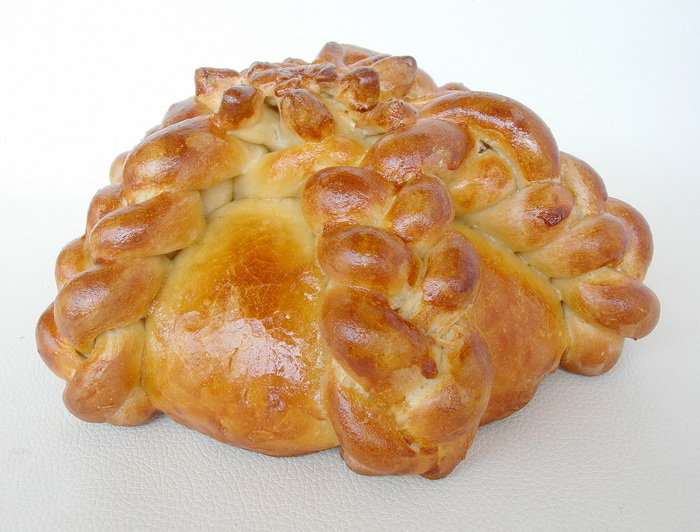
The baked loaf


Savory sautéed
mushroom stuffing.

New Bread Formula
I have created a bread dough formula specifically designed
for braiding, based on the Tangzhong principle for handling flour; and also
containing butter.
Tangzhong is a paste of flour cooked in water or milk at 65
°C, which is used to improve the texture of bread, making it soft and fluffy.
This mixture then holds moisture so that, when added to a bread mix dough it bakes with a soft, fluffy texture and
makes the bread keep for longer. The starch in the flour gels and
contributes to slightly greater rise during baking. The addition of butter
confers added flavor and a more tender texture to the bread.
Adding inclusions to bread.
In the bread baking world, an inclusion is whatever you
incorporate to the basic formula to enhance the recipe; there is a
difference between modifying a formula
or adding to it, the last are inclusions.
A list of diverse inclusions that can be used are suggested, sweet and sour, and the procedure to accomplish them is detailed. Examples of them are shown.

Oats, sunflower and
pumpkin seeds used fo filling the bread.

Carot juice was used as the liquid of the formula; inclusions of oats, sunflower seeds, pumpkin seeds, and cranberries were added to the dough.

Adding cheese to
bread always makes it interesting.

Carnival of colors
resulting from including red peppers and olives in the bread.
Although in my book there are complicated braids, which I encourage you to try as a challenge, at the same time I have developed many braids based on the humble three strand plait. The idea is that if you learn this basic braid you can have a wealth of opportunities to produce fancy breads while you master the other braids.
This is a synopsis of my book “The Art of Braiding Bread”
Why is braiding bread significant
Presentation is very important in nutrition. From the moment we are allowed or decide to choose our own food we select what we want to eat. First we look at it, then we smell it and lastly we taste it. And only then, if all our senses approve, we swallow it. Later we remember what we liked and disliked, in lasting impressions. If when we look at food what we see seems appetizing we are more inclined to smell and taste it. A simple loaf of bread might take away our hunger but a braided loaf announces that somebody spent time preparing something special for a celebration.
or as Master Baker Jeffrey Hamelman expresses in "Bread. A baker's book of techniques and recipes":
There is an immense delight in taking a number of discordant strands of dough and bringing them into a harmony. The beauty of shape, the symmetry of form, the rapport between hand and dough—these have always given braiding a special satisfaction to me. I hope some of that satisfaction finds its way into your hands as well."
Learning How to Braid Dough
If you thought braiding dough was uncomplicated or straightforward you would not be looking at these lines now. In the book we start with the most basic of braids, the one with 3 strands, and then patiently and progressively go up to any number of them, with practical step by step description of the process. Braids have been classified systematically so now it is easy to refer to a particular braid and compare it with other ones.
There are Quick Reference Guides for some braids, which you can print out and have at hand when braiding.
The book offers something even for proficient bread braiders; some chapters present a challenge, in video form, in which braiding is carried to the professional level.
The book is eminently visual, illustrated with more than 690 diagram enhanced pictures and 28 videos. The game plans can be replicated at home at your own pace. Nothing is taken for granted, and you can try the procedures over and over again until you COMPREHEND them. Furthermore, if you don’t succeed today, come back tomorrow.
Earn while you learn
I invite you to buy the book. In the meantime I offer you some excerpts from it.
Thank You
Table of Contents of The Art of Braiding Bread
The Case for Braiding Bread
The Dough
How to roll dough into ropes for braided bread
Learning How to Braid Dough
Braiding a 3 Strand Bread
**Description I
**Description II
*Description III
Building on the 3 Strand Braid
**The Double Rope 3 Strand Braid
**The Triple Rope 3 Strand Braid
Improving the 3 Strand Braid
**The H Arrangement
**The 6 Pointed Star Way
The Universe of the 3 Strand Bread Braid
The Double Decker
The Triple Decker
The 3 x 3
Four Times Three
The Six_Pointed Wreath
How to Control the Size of a Braided Loaf
Bread Wreaths
The Squeeze
Going Beyond 3 Strands
Numbering the Strands
**The 4 Strand Alpha Braid
**The 4 Strand Beta Braid
**The 4 Strand Gamma Braid
**The 4 Strand Delta Braid
**The 4 Strand Epsilon Braid
Braiding with 5 Strands
**The 5 Strand Alpha Braid
**The 5 Strand Beta Braid
**The 5 Strand Gamma Braid
**The 5 Strand Delta Braid
**The Four Strand Zeta Braid
**The Four Strand Eta Braid
**The Five Strand Epsilon Braid
Doing it with 6 Strands
**The 6 Strand Alpha Braid
**The 6 Strand Beta Braid
**The 6 Strand Gamma Braid
**The 6 Strand Delta Braid
**The 6 Strand Epsilon Braid
**The 6 Strand Zeta Braid
The Lattice Braid
The 2/4 Braid
The Twist
The Five Pointed Star Braid
The Octopus Way of Braiding Dough
How to Braid a Round Loaf of Bread
**Variations on the round braid
The Sunburst Bread Braid
Mazes
The Winston Knot
Bread Rings
**Bread Ring Alpha
**Bread Ring Beta
Glossary
The case for braiding bread
Presentation is very important in nutrition. Before ingesting food we try to make sure that it will be safe to do so, and hopefully also enjoyable. To help us with the decision our different senses cooperate with each other. First the eyes must approve it, then the nose has to agree and finally the tongue makes the last pronouncement.
This mass of dough, when baked like it is will give you an acceptable loaf.

But this same amount of dough can be enhanced by braiding it

And your bread will look like this

Braiding the bread gives it added value, a more professional look.
Some people don't know how to or are afraid of braiding bread dough for dread of ruining a batch of it. To get skilled at braiding take about 1 cup (circa 4 oz or 114 g) of all purpose flour and add enough water to make a workable mass. There is no need of kneading this dough, just form ropes with it and practice. You can re-form it as many times as you like. The cost is negligible and it will keep a long time, well wrapped, in the refrigerator. The gluten will give out after having used the dough for some time, discard ¼ of it and replace with new so you don’t lose the feel of the real thing.
I don’t advise using Plasticine or Play-Doh because it will soil your kitchen work surface and doesn’t behave like real bread dough.
The abundance of salt in ”Pate Mort” destroys the gluten of the mixture and again you will not have the experience of the authentic material.
If you want to learn how to braid dough don’t try practicing with yarn, string or rolled up wet paper towels since this will only make things more difficult for you because these materials don’t have the plasticity of the original.
Braiding 3 Strands of Bread Dough
Roll out 3 strands of dough, of equal length and diameter, with tapering ends.

Pinch together the strands at the top.

Have the book in front of you and repeat the moves just as you see them there. In order to guide you I have drawn a red line on the rope you have to move and an arrow showing the direction in which you have to move it; after you did, the displaced strand is again highlighted. At first you will make the moves mechanically, repeat them until you gain an understanding of the process.
There is only one way of braiding 3 strands, but there are several ways of describing or presenting the procedure.
Description I
Take the right hand strand and pull it over the one next to it.

You will obtain this.

Then take the left hand strand and pull it over the one next to it.

And this is what you will get.

That is all there is to it, now keep repeating the moves until you reach the end of the strands.

Description 2 (see the book)
Description 3 (see the book)
The Double Rope 3 Strand Braid.


Note how a simple modification can lead to such an interesting pattern.
The Triple Rope 3 Strand Braid
This carries the multiple strand concept one step further.
There are two variants:
With Parallel Strands

With Bunched Strands

Improving the 3 strand braid
In relatively long braids the inevitable pulling on strands makes the braid become progressively more elongated and consequently uneven. To prevent this, start the braid at the middle of the ropes.


There are also other ways of arranging three strands in order to start the braid from the middle of the ropes. Both techniques I am going to present next will give you a nicely proportioned loaf.
The H Arrangement.
Initial display

The 6 Pointed Star Way
Initial arrangement

The Double Decker
A simple thing like placing one braid on top of another one gives the loaf volume and an appealing visual effect.
Cut off 1/3 of the dough and braid both parts.

The Triple Decker
In this case, holding together the 3 stages with wooden dowels is imperative.


The 3 x 3 Bread Braid


The Six-Pointed Wreath
Yet another idea for using simple three strand braids to make awsome loaves


The Six-Pointed Wreath can also be used as an ornament on a loaf.


How to control the size of a braided loaf
In bread braiding, given a certain amount of dough, the hitherto still unsolved problem was how to manage the size of the bread.

Comparison of two braids, each made with the same amount of dough into 4 ropes but braided using different techniques. The one on the right resulted in a braid 10% shorter (and consequently plumper) than the one on the left.
According to my studies linear braids of 3,4,5 and 6 ropes diminish in length an average of 20 to 25% from strand to finished bread.
Consequently, once you decide how long your braid should be, the ropes you roll should be longer in the corresponding percentage.
Bread Wreaths
They make an attractive centerpiece for any dinner table. Use an inverted plate or bowl to determine the inside diameter of the wreath and then measure its circumference. Calculate the length the ropes should have according to what was mentioned earlier.
In this case the threads must have the same diameter throughout (no tapered ends).

Cover the union where the ends meet with a small braid.
The surface of ropes can be made intriguing by creating epi cuts on them.

Going Beyond 3 Strands
Although having learned to plait with 3 strands may have opened up a whole world of experiences for you, it is in human nature to always want to go beyond. So let’s tackle braiding bread with from 4 to an infinite number of ropes.
The 4 Strand Braids
Since we will be examining multiple ways of braiding 4 strands I have arbitrarily given them names derived from the Greek alphabet for identification.
The 4 Strand Alpha Braid
The finished braid


This is a simple flat braid useful as it is or as a base for a multiple decked loaf. It is also particularly interesting, when braided a bit loosely, if you wish to embed objects in it such as eggs, candles (Saint Lucia Day) or similar, which with other kind of patterns might end with an unbalanced, asymmetrical result.
Greek Easter bread with colored eggs inserted in it, made with a 4 Strand Alpha Braid.

The 4 Strand Beta Braid

The 4 Strand Gamma Braid


The 4 Strand Delta Braid


The finished braid

The 4 Strand Epsilon Braid

It is worthwhile to try this technique because of its versatility. As we shall see further on, its basic moves can be used with any number of strands, from 4 up, even or odd (see further on "The 5 Strand Delta Braid" and “The 6 Strand Alpha Braid”).
To make braiding easier “Quick Reference Guides” are interspersed throughout the book

The Four Strand Zeta
Bread Braid


The Four Strand Eta Bread Braid


Braiding with 5 strands
Delving into various 5 strand braiding techniques I have again taken the liberty of randomly assigning them names derived from the Greek alphabet.The 5 Strand Alpha Braid

The 5 Strand Beta Braid

The 5 Strand Gamma Braid


An interesting feature of this braid is its asymmetrical end result.
The 5 Strand Delta Braid
This plaid uses the same basic moves that were presented in the 4 Strand Epsilon Braid.
The finished braid


The baked loaf

This interesting braid is formed by one side feeding the other and vice versa.
Among other uses, this five strand plait is suitable for long braids because it can easily be started from the middle of the ropes and consequently produce a balanced outcome.


The 6 Strand Alpha Braid
As was mentioned before, the technique used in the 4 Strand Epsilon Braid can be upgraded to any number of strands. This is the example with 6 ropes.
The finished braid

The baked loaf

The 6 Strand Beta Braid

The 6 Strand Gamma Braid
This tress takes the 4 Strand Beta Braid one step further.


The 6 Strand Delta Braid
The finished braid

The baked loaf

The 6 Strand Epsilon Braid
The finished braid

The baked loaf. Notice the chain link arrangement of the strands

The 6 Strand Zeta Braid


This is a very simple but useful plait that can be used in a
multitude of ways.
You can use it as an ornament

or affix it to a base
to give it more volume.

The third choice is to intercalate a filling, sweet or
savory, between braid and base.

Depicted here with a strawberry jam stuffing.
Why the name? Because you use 2 strands but end up working with 4 extremities.
In this case it’s the threads that are numbered and not the positions.

The finished braid

The baked loaf

With this braiding technique the combination of shrinking due to braiding, expansion of proofing and oven spring result in a circa 34% of length diminution from rope to finished bread. That means you will obtain a nice plump loaf with it.
The Twist
Just twisting two ropes of dough together can lead to multiple uses for it. First of all, as is, either baked in free-form or in a pan. It can also be formed into a wreath or serve as a base or top in a multi-decked loaf. A simple mound of dough draped with a twist turns into an impressive loaf. Twisting two ropes also enhances other braids.

Repeat the moves described in the pictures, across an imaginary axis.

A Video is presented showing how a simple twisted dough rope wrapped around a core results in a nice dome shaped loaf.


A braided twist makes an interesting wreath.


How to Braid a Round Loaf of Bread
Arrange the threads as shown below

The braided dough

The baked loaf

Variations on The Round Braid


Watch the video
Mazes
The purpose of braiding dough is to make bread more attractive. Mazes are a completely different way of making pretty and intriguing looking braided loafs of bread, based on a single strand of dough.


To introduce you to how to make bread mazes I am going to give detailed instructions on how to make loaves of specific sizes (ergo weighs). As blueprints for the shapes we will use four geometric forms: triangle, square, pentagon and hexagon. These can be downloaded; and 8 videos will show you the mechanics of the proceedings. Once you have mastered the set procedures you can adapt them to your particular needs.
There is a basic sequence of steps for making the Winston Knot with scope for variations regarding the length of the braid and number of threads comprising it.


Sharing bread has always been part of many communities’ celebrations. Decorative bread, especially in the form of a ring or circle, enhances the relevance of the ceremony with its powerful symbolic meanings.


 |
| In dough form |
 |
The Baked Bread |
Your remarks are welcome, post them at the end of this page, at the Comments section.
